Tracing Neotropical springs in crystalline rocks: Hydrogeochemical and statistical insights
DOI:
https://doi.org/10.32685/0120-1425/bol.geol.52.2.2025.759Palabras clave:
agua vadosa, interacciones hidrometeorológicas, hidrogeología tropical, caracterización hidroquímica, análisis multivariado, sistemas acuíferos montañosos, agua subterránea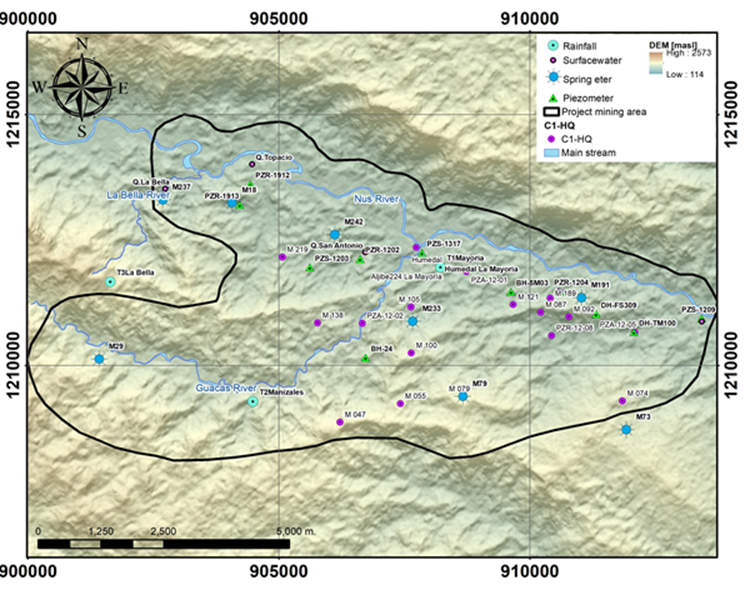
Licencia
Derechos de autor 2025 Servicio Geológico Colombiano

Esta obra está bajo una licencia internacional Creative Commons Atribución 4.0.
Descargas
Cómo citar
Número
Sección
Publicado
Resumen
Históricamente, se ha reconocido la importancia hidrogeológica, ecosistémica y cultural de los manantiales para proteger las aguas subterráneas y superficiales. Sin embargo, en Colombia los estudios sobre el agua de manantial son escasos y no existe una metodología establecida para su correcta clasificación, especialmente en zonas tropicales, donde los sistemas hidrogeológicos son altamente complejos debido a la topografía abrupta, las altas precipitaciones y el desarrollo de suelos gruesos.
El objetivo principal de este estudio fue dilucidar las interacciones del agua de lluvia y los procesos hidroquímicos a medida que esta se infiltra, fluye e interactúa con el medio subterráneo en una zona montañosa del municipio de San Roque, Departamento de Antioquia, para determinar si el agua que emerge en la superficie es subterránea o vadosa. Para este propósito, se realizaron análisis hidrogeoquímicos y estadísticas de agrupación multivariada, en el contexto del conocimiento hidrogeológico del área, utilizando datos in situ fisicoquímicos y de calidad de distintos tipos de agua.
Los resultados muestran que no todos los puntos de muestreo identificados en la zona de estudio pueden clasificarse como agua de manantial; algunos presentan una relación directa con el agua de lluvia sin necesariamente descargar de la zona saturada. Nuestros resultados proporcionan una evaluación preliminar de la investigación y la clasificación de las aguas de manantial en Colombia, lo cual es crucial para afinar los lineamientos actuales sobre la declaración de zonas protegidas y la utilización del suelo asociada al recurso de agua subterránea.
Referencias bibliográficas
Appelo, C.A.J.; Postma, D. (2005). Geochemistry, groundwater and pollution. 2nd ed. CRC Press. https://doi.org/10.1201/9781439833544
Champ, D.R; J. Gulens, J; Jackson R. E. . 1979. Oxidation–reduction sequences in ground water flow systems. Canadian Journal of Earth Sciences. 16(1): 12-23. https://doi.org/10.1139/e79-002
Chen, T.; Zhang, H.; Sun, C.; Li, H.; Gao, Y. (2018). Multivariate statistical approaches to identify the major factors governing groundwater quality. Applied Water Science, 8(7), 1–6. https://doi.org/10.1007/s13201-018-0837-0
Cloutier, V.; Lefebvre, R.; Therrien, R.; Savard, M.M. (2008). Multi-variate statistical analysis of geochemical data as indicative of the hydrogeochemical evolution of groundwater in a sedimentary rock aquifer system. Journal of Hydrology, 353(3–4), 294–313. https://doi.org/10.1016/j.jhydrol.2008.02.015
Custodio, E.; Llamas, M. (1975). Hidrología subterránea. Barcelona: Editorial Omega, vol. 2.
Davis, J. (1986). Statistics and data analysis in Geology. New York: John Wiley and Sons, Inc.
De la Fuente, S. (2011). Análisis de correspondencias simples y múlti-ples. Facultad de Ciencias Económicas y Empresariales Universidad Autónoma de Madrid. https://www.fuenterrebollo.com/Economicas/ECONOMETRIA/REDUCIR-DIMENSION/CORRESPONDENCIAS/correspondencias.pdf
Doménico, P., & Schawartz, F. (1997). Physical and Chemical Hydro-geology. New York, USA.: John Wiley E Sons, Inc.
Elango, L.; Kannan, R. (2007). Chapter 11 Rock-water interaction and its control on chemical composition of groundwater. Developments in Environmental Science, 5(07), 229–243. https://doi.org/10.1016/S1474-8177(07)05011-5
Freeze, R.; Cherry, J. (1979). Groundwater. N.J: Prentice-Hall.
Gibbs, R. (1970). Mechanisms controlling world water chemistry. Science, New Series, Vol. 170, (3962), 1088-1090. https://doi.org/10.1126/science.170.3962.1088
Golder Associates (2014). Evaluación hidrogeológica. Documento soporte para la EIA. Medellín.Colombia
Güler, C.; Thyne, G.; McCray, J.; Turner, A. (2002). Evaluation of graphical and multivariate statistical methods for classification of water chemistry data. Hydrogeology Journal, 10(4), 455–474. https://doi.org/10.1007/s10040-002-0196-6
Güler, C.; Thyne, G.D. (2004). Hydrologic and geologic factors con-trolling surface and groundwater chemistry in Indian Wells-Owens Valley area, southeastern California, USA. Journal of Hydrology, 285(1–4), 177–198. https://doi.org/10.1016/j.jhydrol.2003.08.019
Hounslow, A. (1995). Water quality data: analysis and interpretation. Boca Raton. CRC Press LLC, Lewis Publishers
ICONTEC (2014). Guía técnica colombiana GTC-ISO 30. Bogotá: Instituto Colombiano de Normas Técnicas y Certificación (ICON-TEC)
Integral S.A. (2015). Estudio de impacto Ambiental proyecto de minería de oro a cielo abierto Gramalote. Medellín. Colombia.
Instituto de Hidrología, Meteorología y Estudios Ambientales – IDEAM (2021). Consulta y descarga de datos hidrometeorológicos. Disponible en http://dhime.ideam.gov.co/atencionciudadano/. Re-covered 05-11-2022.
Jalali, M. (2006). Chemical characteristics of groundwater in parts of mountainous region, Alvand, Hamadan, Iran. Environmental Geol-ogy, 51(3), 433–446. https://doi.org/10.1007/s00254-006-0338-6
Jalali, M. (2007). Assessment of the chemical components of Famenin groundwater, western Iran. Environmental Geochemistry and Health, 29(5),357–374. https://doi.org/10.1007/s10653-006-9080-y
Jalali, M. (2016). Geochemistry and background concentration of major ions in spring waters in a high-mountain area of the Hamedan (Iran). Journal of Geochemical Exploration. 165, 49–61. https://doi.org/10.1016/j.gexplo.2016.02.002
Kumar, S.K.; Rammohan, V.; Sahayam, J.D.; Jeevanandam, M. (2009). Assessment of groundwater quality and hydrogeochemistry of Manimuktha River basin, Tamil Nadu, India. Environmental Moni-toring and Assessment, 159(1–4), 341–351. https://doi.org/10.1007/s10661-008-0633-7
Lakshmanan, E.; Kannan, R.; Senthil Kumar, M. (2003). Major ion chemistry and identification of hydrogeochemical processes of ground water in a part of Kancheepuram district, Tamil Nadu, India. Environmental Geosciences, 10(4), 157–166. https://doi.org/10.1306/eg.0820303011
Lourenço, C.; Ribeiro, L; Cruz, J. (2010). Classification of natural mineral and spring bottled waters of Portugal using Principal Com-ponent Analysis. Journal of Geochemical Exploration, 107, 362–372. https://doi.org/10.1016/j.gexplo.2010.08.001
Malagón, J.P.; Piña, A.; Argüello, S; Donado, L.D. (2021). Análisis hidrogeoquímico multivariado del agua subterránea del sistema acuí-fero del Valle Medio del Magdalena, Colombia: Estudio a escala re-gional. Boletín de la Sociedad Geológica Mexicana, 73(3), A070421. http://dx.doi.org/10.18268/BSGM2021v73n3a070421
Marín, J.M. (2021). Estadística descriptiva y análisis de datos.Tema 4: Transformaciones de variables. Available in: http://halweb.uc3m.es/esp/Personal/personas/jmmarin/esp/EDescrip/tema4.pdf. Recovered: 06-05-2021
Marandi, A.; Shand, P. (2018). Groundwater chemistry and the Gibbs diagram. Applied Geochemistry, 97, 209–212. https://doi.org/10.1016/j.apgeochem.2018.07.009
Mazor, E. (2003). Chemical and isotopic groundwater hydrology. 3rd edition. CRC Press
Minitab Inc. State (2021). Minitab Release 14®. (C. Pensilvania, Ed.) EE. UU.
Mostaza-Colado, D.; Carreño-Conde, F.; Rasines-Ladero, R.; Iepure, S. (2018). Hydrogeochemical characterization of a shallow alluvial aq-uifer: 1 baseline for groundwater quality assessment and resource management. Science of the Total Environment, 639, 1110–1125. https://doi.org/10.1016/j.scitotenv.2018.05.236
Pazand, K., Javanshir, A.R. (2016). Application of multivariate statisti-cal techniques in hydrogeochemical evolution of groundwater in an igneous rock and sedimentary aquifer system: a case study of the southern Bam, SE Iran. Carbonates and Evaporites, 31(1), 9–16. https://doi.org/10.1007/s13146-015-0234-9
Piper, A.M. (1944). A graphic procedure in the geochemical interpreta-tion of water-analyses. Eos, Transactions American Geophysical Union, 25(6), 914-928. https://doi.org/10.1029/TR025i006p00914
Ragno, G.; De Luca, M.; Ioele, G. (2007). An application of cluster analysis and multivariate classification methods to spring water monitoring data. Microchemical Journal, 87(2), 119–127. https://doi.org/10.1016/j.microc.2007.06.003
Rabajczyk, A.; Namieśnik, J. (2014). Speciation of Iron in the Aquatic Environment. Water Environment Research, 86(8), 741–758. http://www.jstor.org/stable/24585466
Ravikumar, P.; Somashekar, R.K. (2017). Principal component analysis and hydrochemical facies characterization to evaluate groundwater quality in Varahi river basin, Karnataka state, India. Applied Water Science, 7, 745–755. https://doi.org/10.1007/s13201-015-0287-x
Rodier, J. (1981). Análisis de las aguas. Barcelona: Omega.
Redlands, C. E. S. R. I. (2011). ESRI 2011. ArcGIS Desktop: Release 10
Singh, K.P.; Malik, A.; Mohan, D.; Sinha, S. (2004). Multivariate statistical techniques for the evaluation of spatial and temporal varia-tions in water quality of Gomti River (India) - A case study. Water Research, 38(18), 3980–3992. https://doi.org/10.1016/j.watres.2004.06.011
Simler, R. (2021). Logiciel d'hydrochimie- Water Software Quality Hydrochemistry diagrams, DIAGRAMMES: http://www.lha.univ-avignon.fr/LHA-Logiciels.htm. Recovered 14-11-2021
Springer, A.; Stevens., L. (2008). Spheres of discharge of springs. Hydrogeology Journal, 17, 11. https://doi.org/10.1007/s10040-008-0341-y
Stevens, L.; Ledbetter, J.; Springer, A. (2012). Springs inventory and assessment training manual, Version 2.01. Springs Stewardship In-stitute, Museum of Northern Arizona, Flagstaff. Obtenido de http://springstewardship.org/workshops.html Recovered 18-11-2021
Swan, A.; Sandilands, M. (1995). Introduction to geological data analy-sis. Oxford: Blackwell Science: Blackwell Science.
Tesoriero, A. J.; Wherry, S. A.; Dupuy, D. I.; Johnson, T. D. (2024). Predicting Redox Conditions in Groundwater at a National Scale Using Random Forest Classification. Environmental Science & Technology,58(11),5079-5092. https://doi.org/10.1021/acs.est.3c07576pubs.acs.org+2pubmed.ncbi.nlm.nih.gov+2
Toro, M.T. (2020). Groundwater resources of the western Andean front: insights from the Aconcagua basin, central Chile. Tesis para optar al grado de doctor en ciencias mención geología. Santiago de Chile: Universidad de Chile. https://repositorio.uchile.cl/bitstream/handle/2250/176630/Groundwater-resources-of-the-Western-Andean-Front-insights-from-the-Aconcagua-Basin.pdf?sequence=1&isAllowed=y
Zhang, B.; Zhao, D.; Zhou, P.; Qu, S.; Liao, F.; Guangcai, W. (2020). Hydrochemical characteristics of groundwater and dominant water – rock interactions in the Delingha Area, Qaidam Basin, Northwest-ern China. Water, 12(836), 1–16. https://doi.org/10.3390/w12030836.
Von der Heyden, B. P.; Roychoudhury, A. N. (2015). Application, chemical interaction and fate of iron minerals in polluted sediment and soils. Current Pollution Reports, 1, 265–279. https://doi.org/10.1007/40726-015-0020-2