Magmatic Evolution of the Panales Caldera: Chemo- mineralogical characterization of the El Torito Dome, Mexico
DOI:
https://doi.org/10.32685/0120-1425/bol.geol.52.2.2025.764Palabras clave:
petrología, geotermometría, geobarometría, adakita, estado de Hidalgo, México central, Faja Volcánica Transmexicana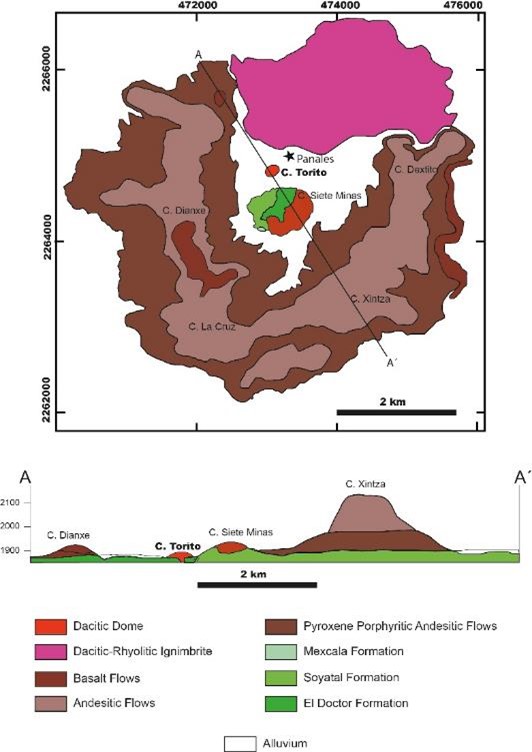
Licencia
Derechos de autor 2025 Servicio Geológico Colombiano

Esta obra está bajo una licencia internacional Creative Commons Atribución 4.0.
Descargas
Cómo citar
Número
Sección
Publicado
Resumen
El objetivo del presente trabajo es determinar el significado petrogenético de un domo de dacita ubicado en el centro de México, y correlacionarlo con la evolución geológica del sector oriental de la Faja Volcánica Transmexicana, misma que atraviesa parte de la porción sudoccidental del estado de Hidalgo. Para ello, se realizaron campañas de trabajo de campo, estudio petrográfico y análisis químico cuantitativo de minerales y vidrio constitutivo de la roca mediante microscopio electrónico de barrido, complementado con el análisis geoquímico de roca total y de algunos elementos traza. En el trabajo de campo se identifica al domo dacítico de 0.5 km2, como domo central resurgente de la caldera Panales, de 7 km2, la cual es probablemente del Mioceno-Plioceno tardío.
Petrográfica y geoquímicamente, el domo es una dacita de anfíbol, calco alcalina, sódica, medianamente potásica y ligeramente peralcalina (A/CNK=1.1). La geotermometría y geobarometrìa indican una profundidad de formación cortical-intermedia, entre los 14.8 y 17.4 km (4.0 a 4.7 kbar), y en un rango de temperatura de ~950 a ~800 °C. Tomando como base la caracterización del domo y correlacionándolo con series volcánicas adyacentes de este sector oriental de la Faja Volcánica Transmexicana, se manifiestan el significado petrogenético del domo estudiado y la evidencia concluyente de la ocurrencia de vulcanismo adakítico, omnipresente a lo largo de la Faja Volcánica Transmexicana
Referencias bibliográficas
Acocella, V. (2007). Understanding caldera structure and development: An overview of analogue models compared to natural calderas. Earth-Science Re-views, 85(3–4), 125–160. https://doi.org/10.1016/j.earscirev.2007.08.004
Aguirre-Díaz, G. J. (2019). Volcanic stratigraphy of the Amealco caldera and vicinity, central Mexican Volcanic Belt. Revista Mexicana De Ciencias Geológi-cas, 13(1), 10–51. Retrieved from https://rmcg.geociencias.unam.mx/index.php/rmcg/article/view/1135
Aguirre-Díaz, G.J., Nelson, S.A., Ferrari, L., López-Martínez, M. (1997). Ignimbrites of the central Mexican Volcanic Belt, Amealco and Huichapan calderas (Querétaro- Hidalgo). In: Aguirre-Díaz, G.J., Aranda-Gómez, J.J., Carrasco-Núñez, G., Ferrari, L. (Eds.), Magmatism and Tectonics of central and northwestern México—A selection of the 1997 IAVCEI General Assembly excursions, vol. 1. UNAM, Instituto de Geología, Excursión, México, D.F., pp. 1–39.
Aguirre-DíAz, G. J., & McDowell, F. W. (2000). Volcanic evolution of the Amealco caldera, central Mexico. In Geological Society of America eBooks. https://doi.org/10.1130/0-8137-2334-5.179
Anguita, F., Verma, S. P., Cacho, L. G., Milán, M., & Samaniego-M, D. (1991). Mazahua: una nueva caldera en el Cinturón Volcánico Mexicano. Geofísica Inter-nacional, 30(3), 135–148. https://doi.org/10.22201/igeof.00167169p.1991.30.3.596
Anguita, F., Verma, S. P., Márquez, A., Vasconcelos-F, M., López, I., & Laurrieta, A. (2001). Circular features in the Trans-Mexican Volcanic Belt. Journal of Volcanology and Geothermal Research, 107(4), 265–274. https://doi.org/10.1016/s0377-0273(00)00297-3
Annen, C., Blundy, J. D., & Sparks, R. S. J. (2005). The genesis of intermediate and silicic magmas in deep crustal hot zones. Journal of Petrology, 47(3), 505-539. https://doi.org/10.1093/petrology/egi084
Aparicio-Canales, O., Contreras-Cruz, D. (2016). Caracterización petrográfica y geoquímica de las rocas volcánicas del área de Epazoyucan-Singuilucan, estado de Hidalgo: Mexico, Autonomous University of the State of Hidalgo, senior thesis, 116 p.
Avellán, D. R., Macías, J. L., Layer, P. W., Cisneros, G., Sánchez-Núñez, J. M., Gómez-Vasconcelos, M. G., Pola, A., Sosa-Ceballos, G., García-Tenorio, F., Reyes-Agustín, G., Osorio-Ocampo, S., García-Sánchez, L., Mendiola I. F., Martí, J., López-Loera, H., Benowits, B. (2019). Geology of the late Pliocene – Pleisto-cene Acoculco caldera Complex, eastern Trans-Mexican Volcanic Belt (Mexico). Journal of Maps 15 (2), 8-18. https:doi.org/10.1080/17445647.2018.1531075
Barker, F. (1979). Trondhjemite: Definition, Environment and Hypotheses of Origin. In Developments in petrology (pp. 1–12). https://doi.org/10.1016/b978-0-444-41765-7.50006-x
Barrera-Guerrero, S. & Ortiz-Hernandez, L. E. (2007). Episodios volcánicos en la Caldera Tolteca, estados Hidalgo, Mexico y Queretaro, México. XIII Congreso Nacional de Geoquímica, Pachuca de Soto, Hidalgo, México, Actas INAGEQ, 13 (1), 18-21.
Barrera-Guerrero, S. (2009). Caracterización geológica de la estructura semicircular Panales, Ixmiquilpan, estado de Hidalgo, México: Mexico, Autonomous University of the State of Hidalgo, senior thesis, 191 p.
Campos-Enriquez, J., & Gardun˜o-Monroy, V. (1995). Los Azufres silicic center (Mexico): inference of caldera structural elements from gravity, aeromagnetic, and geoelectric data. Journal of Volcanology and Geothermal Research, 67(1–3), 123–152. https://doi.org/10.1016/0377-0273(94)00094-w
Castro-García, A., Córdoba-Méndez, D. (1994). Estratigrafía del área volcánica de Tulancingo, Hidalgo, México. Pancromo 23, Universidad Autónoma del Es-tado de Hidalgo, 1, 1, 26-39.
Carmichael, I. S. E. (1991). The redox states of basic and silicic magmas: a reflection of their source regions? Contributions to Mineralogy and Petrology, 106(2), 129–141. https://doi.org/10.1007/bf00306429
Carrasco, V. B. (1971). Litofacies de la Formación El Abra en la plataforma de Actopan, Hidalgo., México: Revista del Instituto Mexicano del Petróleo, 3, 1, 5-28
Cole, J., Milner, D., & Spinks, K. (2004). Calderas and caldera structures: a review. Earth-Science Reviews, 69(1–2), 1–26. https://doi.org/10.1016/j.earscirev.2004.06.004
Coltorti, M., Bonadiman, C., Faccini, B., Grégoire, M., O’Reilly, S. Y., & Powell, W. (2007). Amphiboles from suprasubduction and intraplate lithospheric man-tle. Lithos, 99(1–2), 68–84. https://doi.org/10.1016/j.lithos.2007.05.009
Consejo de Recursos Minerales, 1995, Carta geológico-minera Ixmiquilpan (F14-C79) escala 1: 50,000.
Defant, M. J., & Drummond, M. S. (1990). Derivation of some modern arc magmas by melting of young subducted lithosphere. Nature, 347(6294), 662-665. https://doi.org/10.1038/347662a0
Demant, A. (2019). Las fases del vulcanismo en México; una síntesis en relación con la evolución geodinámica desde el Cretácico. Revista Mexicana De Ciencias Geológicas, (1), 70–83. Retrieved from https://rmcg.geociencias.unam.mx/index.php/rmcg/article/view/1484
Dimalanta, C. B., & Yumul, G. P., Jr. (2008). Crustal thickness and adakite occurrence in the Philippines: Is there a relationship? Island Arc, 17(4), 421–431. https://doi.org/10.1111/j.1440-1738.2008.00634.x
Drummond, M. S., Defant, M. J., & Kepezhinskas, P. K. (1996). Petrogenesis of slab-derived trondhjemite–tonalite-dacite/adakite magmas. In Geological Society of America eBooks. https://doi.org/10.1130/0-8137-2315-9.205
Elkins, L.T., Grove, T.L. (1990). Ternary feldspar experiment and thermodynamic models: American Mineralogist, 75, 544-559.
Ernst, W. G., & Liu, J. (1998). Experimental phase-equilibrium study of Al- and Ti-contents of calcic amphibole in MORB; a semiquantitative thermobarome-ter. American Mineralogist, 83(9–10), 952–969. https://doi.org/10.2138/am-1998-9-1004
Esawi, E. (2004). AMPH-CLASS: An Excel spreadsheet for the classification and nomenclature of amphiboles based on the 1997 recommendations of the Interna-tional Mineralogical Association. Computers & Geosciences, 30(7), 753–760. https://doi.org/10.1016/j.cageo.2004.05.007
Ferrari, L., Orozco-Esquivel, T., Manea, V., & Manea, M. (2011). The dynamic history of the Trans-Mexican Volcanic Belt and the Mexico subduction zone. Tectonophysics, 522–523, 122–149. https://doi.org/10.1016/j.tecto.2011.09.018
Ferriz, H., & Mahood, G. A. (1987). Strong compositional zonation in a silicic magmatic system: Los Humeros, Mexican Neovolcanic Belt. Journal of Petrolo-gy, 28(1), 171–209. https://doi.org/10.1093/petrology/28.1.171
Frost, B. R., Barnes, C. G., Collins, W. J., Arculus, R. J., Ellis, D. J., & Frost, C. D. (2001). A geochemical classification for granitic rocks. Journal of Petrolo-gy, 42(11), 2033–2048. https://doi.org/10.1093/petrology/42.11.2033
Galetto, F., Acocella, V., & Caricchi, L. (2017). Caldera resurgence driven by magma viscosity contrasts. Nature Communications, 8, 1750. https://doi.org/10.1038/s41467-017-01632
García-Palomo, A., Macías, J. L., Tolson, G., Valdez, G., Mora, J. C. (2002). Volcanic stratigraphy and geological evolution of the Apan region, east-central sector of the Trans-Mexican Volcanic Belt: Geofísica Internacional, 41, 2, 133-150. https://doi.org/10.22201/igeof.00167169p.2002.41.2.282
García-Palomo A., Macías J. L., Jiménez A., Tolson, G., Mena, M., Sánchez-Núñez, J. M., Arce J. L.; Layer, P. W., Santoyo, M. A., Lermo-Samaniego, J. (2018). NW-SE Pliocene-Quaternary extension in the Apan-Acoculco region, eastern Trans-Mexican Volcanic Belt: Journal of Volcanology and Geothermal Research, 349, 240-255. doi.org/10.1016/j.jvolgeores.2017.11.005
García-Tovar, G. P., Martínez-Serrano, R. G., Solé, J., Correa-Tello, J. C., Núñez-Castillo, E. Y., Guillou, H., & Monroy-Rodríguez, E. (2015). Geología, geo-cronología y geoquímica del vulcanismo Plio-Cuaternario del Campo Volcánico Apan-Tecocomulco, Faja Volcánica Trans-Mexicana. Revista Mexicana De Cien-cias Geológicas, 32(1). Retrieved from https://rmcg.geociencias.unam.mx/index.php/rmcg/article/view/278
Geyer, A., & MartÃ, J. (2014). A short review of our current understanding of the development of ring faults during collapse caldera formation. Frontiers in Earth Science, 2. https://doi.org/10.3389/feart.2014.00022
Geyne, A. R., Fries, C., Segerstrom, K., Black, R. F., Wilson, I. F., 1990, Geology and Mineral Deposits of the Pachuca-Real del Monte District, Hidalgo, México, in, Clark, K. F.; Thompson, T. B., (eds.), Mexican Silver Deposits: Australia, Society of Economic Geologists Guidebook Series, Society of Economic Geologists, 6, 241-258. https://doi.org/10.5382/GB.06
Gómez-Tuena, A., Orozco-Esquivel, T., Ferrari, L. (2005). Igneous petrogenesis of the Trans Mexican Volcanic Belt: Boletín de la Sociedad Geológica Mexicana, LVII, 3, 227-283. doi.org/10.18268/bsgm2005v57n3a2.
Green, T. H., & Watson, E. B. (1982). Crystallization of apatite in natural magmas under high pressure, hydrous conditions, with particular reference to ?Orogenic? rock series. Contributions to Mineralogy and Petrology, 79(1), 96–105. https://doi.org/10.1007/bf00376966
Hammarstron, J.M., Zen, E. (1986). Aluminium in hornblende: An empirical igneous geobarometer: American Mineralogist, 71, 1297-1313.
Hastie, A.R., Mitchell, S.F., Treloar, P.J., Kerr, A.C., Neill, I., Barfod, D.N. (2013). Geochemical components in a Cretaceous island arc: the Th/La–(Ce/Ce∗)Nd diagram and implications for subduction initiation in the inter-American region: Lithos,162–163, 57-69. doi: 10.1016/j.lithos.2012.12.001
Holland, T., & Blundy, J. (1994). Non-ideal interactions in calcic amphiboles and their bearing on amphibole-plagioclase thermometry. Contributions to Mineralogy and Petrology, 116(4), 433–447. https://doi.org/10.1007/bf00310910
Hollister, L. S., Grissom, G. C., Peters, E. K., Stowell, H. H., & Sisson, V. B. (1987). Confirmation of the empirical correlation of Al in hornblende with pressure of solidification of calc-alkaline plutons. American Mineralogist, 72, 231–239. https://ammin.geoscienceworld.org/content/72/3-4/231
Hollocher, K., 2004, CIPW Norm Calculation Program. Geology Department, Union College.
Johnson M.C & Rutherford, M.J. (1989). Experimental calibration of the aluminum-in-hornblende geobarometer with application to Long Valley caldera
(California) volcanic rocks. Geology, 17(9), 837-841. https://doi.org/10.1130/0091-7613(1989)017%3C0837:ECOTAI%3E2.3.CO;2
Jung, S., Pfänder, J.A. (2007). Source composition and melting temperatures of orogenic granitoids-constraints from CaO/Na2O, Al2O3/TiO2 and accessory miner-al saturation thermometry: European Journal of Mineralogy, 19, 6, 859-870. https://doi.org /10.1127/0935-1221/2007/0019-1774
Juárez-López, K., 2015, Evidencias de procesos magmáticos: Caracterización geoquímica e isotópica (Sr, Nd, Pb) del Campo Volcánico Chichicuautla-Tecocomulco, Estado de Hidalgo. México, Universidad Nacional Autónoma de México, Master’s Thesis, 141 p.
Kiyokawa, M., 1981, Report on geological survey of the Pachuca-Zimapán area, central Mexico; phase II: México, Consejo de Recursos Minerales México, Metal Mining Agency of Japan & Japan International Cooperation Agency. 195 p.
Kiyokawa, M., 1982, Report on geological survey of the Pachuca-Zimapán area, central Mexico; phase III: Mexico, Consejo de Recursos Minerales México, Metal Mining Agency of Japan & Japan International Cooperation Agency. 121 p.
Lange, R. A., Frey, H. M., & Hector, J. (2009). A thermodynamic model for the plagioclase-liquid hygrometer/thermometer. American Mineralogist, 94(4), 494–506. https://doi.org/10.2138/am.2009.3011
Leake, B. E., Woolley, A. R., Arps, C. E. S., Birch, W. D., Gilbert, M. C., Grice, J. D., Hawthorne, F. C., Kato, A., Kisch, H. J., Krivovichev, V. G., Linthout, K., Laird, J., Mandarino, J., Maresch, W. V., Nickel, E. H., Rock, N. M. S., Schumacher, J. C., Smith, D. C., Stephenson, N. C. N., . . . Youzhi, G. (1997). Nomenclature of amphiboles; Report of the Subcommittee on Amphiboles of the International Mineralogical Association Commission on New Minerals and Mineral Names. Mineralogical Magazine, 61(405), 295–310. https://doi.org/10.1180/minmag.1997.061.405.13
Lipman, P. W. (1997). Subsidence of ash-flow calderas: relation to caldera size and magma-chamber geometry. Bulletin of Volcanology, 59(3), 198–218. https://doi.org/10.1007/s004450050186
Lipman, P. W., Zimmerer, M. J., & McIntosh, W. C. (2015). An ignimbrite caldera from the bottom up: Exhumed floor and fill of the resurgent Bonanza caldera, Southern Rocky Mountain volcanic field, Colorado. Geosphere, 11, 1902–1947.
López-Hernández, A., García-Estrada, G., Aguirre-Díaz, G., González-Partida, E., Palma-Guzmán, H., & Quijano-León, J. L. (2009). Hydrothermal activity in the Tulancingo–Acoculco Caldera Complex, central Mexico: Exploratory studies. Geothermics, 38(3), 279–293. https://doi.org/10.1016/j.geothermics.2009.05.001
Lucci, F., Carrasco‐Núñez, G., Rossetti, F., Theye, T., White, J. C., Urbani, S., Azizi, H., Asahara, Y., & Giordano, G. (2020). Anatomy of the magmatic plumbing system of Los Humeros Caldera (Mexico): implications for geothermal systems. Solid Earth, 11(1), 125. https://doi.org/10.5194/se-11-125-2020
Luo, C., Wang, R., Nebel, O., & Li, Q. (2024). Amphibole fractionation as a key driver for oxidation of magmas in convergent margins. Earth and Planetary Sci-ence Letters, 641, 118851. https://doi.org/10.1016/j.epsl.2024.118851
Macpherson, C. G., Dreher, S. T., & Thirlwall, M. F. (2006). Adakites without slab melting: High pressure differentiation of island arc magma, Mindanao, the Phil-ippines. Earth and Planetary Science Letters, 243(3–4), 581–593. https://doi.org/10.1016/j.epsl.2005.12.034
Mahood, G. A. (1980). Geological evolution of a pleistocene rhyolitic center — Sierra La Primavera, Jalisco, México. Journal of Volcanology and Geothermal Research, 8(2–4), 199–230. https://doi.org/10.1016/0377-0273(80)90105-5
Martínez-González, I.R., 2018, Aportaciones petrográficas, geoquímicas e isotópicas, en la caracterización petrogenética de rocas volcánicas de la sierra de Pachuca. Mexico, Universidad Nacional Autónoma de Mexico, Facultad de Ciencias, Senior thesis, 120 p.
McCulloch, M., Gamble, J. (1991). Geochemical and geodynamical constraints on subduction zone magmatism. Earth and Planetary Science Letters, 102(3–4), 358–374. https://doi.org/10.1016/0012-821x(91)90029-h
Martin, H., Smithies, R., Rapp, R., Moyen, J., & Champion, D. (2005). An overview of adakite, tonalite–trondhjemite–granodiorite (TTG), and sanukitoid: relation-ships and some implications for crustal evolution. Lithos, 79(1–2), 1–24. https://doi.org/10.1016/j.lithos.2004.04.048
Mitlán, M., Yañez, C., Navarro L., I., & Verma, S. P. (1993). Geología y geoquímica de elementos mayores de la Caldera de Huichapan, Hidalgo, Méxi-co. Geofísica Internacional, 32(2), 261–276. https://doi.org/10.22201/igeof.00167169p.1993.32.2.560
Mooser, F. (1972). The Mexican Volcanic Belt structure and tectonics. Geofísica Internacional, 12(2), 55–70. https://doi.org/10.22201/igeof.00167169p.1972.12.2.1024
Moyen, J. (2009). High Sr/Y and La/Yb ratios: The meaning of the “adakitic signature.” Lithos, 112(3–4), 556–574. https://doi.org/10.1016/j.lithos.2009.04.001
Negendank, J. F. W., Emmermann, R., Krawczyk, R., Mooser, F., Tobschall, H., & Werle, D. J. (1985). Geological and geochemical investigations on the eastern Trans-Mexican Volcanic Belt. Geofísica Internacional, 24(4), 477–575. https://doi.org/10.22201/igeof.00167169p.1985.24.4.2178
Ortiz-Hernández, L. E., Hernández-Avelino I. (2006). Caracterización de la caldera Mezquital, estado de Hidalgo. V Reunión Nacional de Ciencias de la Tierra, resumen. 15-17 septiembre 2006, Puebla, Pue.
Ortiz-Hernández, L. E. O. & Escamilla-Casas, J. C. (2021). Mineralogía y geoquímica de un intrusivo diorítico del centro de México. Tópicos De Investigación En Ciencias De La Tierra Y Materiales, 8(8), 47–53. https://doi.org/10.29057/aactm.v8i8.7505
Otten, M. T. (1984). The origin of brown hornblende in the Artfjället gabbro and dolerites. Contributions to Mineralogy and Petrology, 86(2), 189–199. https://doi.org/10.1007/bf00381846
Pearce, J. A. (1982). Trace element characteristics of lavas from destructive plate boundaries. In John Wiley and Sons eBooks (pp. 525–548). http://orca.cf.ac.uk/8625/
Pearce, J.A. (1996). A User’s Guide to Basalt Discrimination Diagrams. In: Wyman, D.A., Ed., Trace Element Geochemistry of Volcanic Rocks: Applications for Massive Sulphide Exploration, Geological Association of Canada, Short Course Notes, Vol. 12, 79-113.
Putirka, K. D. (2008). Thermometers and barometers for volcanic systems. Reviews in Mineralogy and Geochemistry, 69(1), 61–120. https://doi.org/10.2138/rmg.2008.69.3
Putirka, K. (2016). Amphibole thermometers and barometers for igneous systems and some implications for eruption mechanisms of felsic magmas at arc volca-noes. American Mineralogist, 101(4), 841–858. https://doi.org/10.2138/am-2016-5506
Qian, Q., & Hermann, J. (2013). Partial melting of lower crust at 10–15 kbar: constraints on adakite and TTG formation. Contributions to Mineralogy and Petrolo-gy, 165(6), 1195–1224. https://doi.org/10.1007/s00410-013-0854-9
Ramírez-Ramírez, B. B., 2016, Campo volcánico San Vicente, estado de Hidalgo, Faja Volcánica Trans-mexicana: variaciones geoquímicas e isotópicas y su rela-ción con el retroceso del arco hacia la trinchera: Mexico, Instituto Politécnico Nacional, ESIA-Unidad Ticomán, Master’s thesis, 157 p.
Reyes-Moreno, J. R., Corona, F. P., Santillán, I. Á., & Hernández, L. O. (2019). Combinación de métodos potenciales y percepción remota para el análisis geológi-co-estructural de la caldera panales, Hidalgo, México. Tópicos De Investigación En Ciencias De La Tierra Y Materiales, 6(6), 123–129. https://doi.org/10.29057/aactm.v6i6.5021
Ribeiro, L. J., 2007, Magmas adakitiques: composition des amphiboles et contraintes géo barométriques. Université Bretagne Occidentale, Mémoire de stage de Master 2, Spécialité: Géochimie et pétrologie, 85 p.
Rudnick, R. L., & Fountain, D. M. (1995). Nature and composition of the continental crust: A lower crustal perspective. Reviews of Geophysics, 33(3), 267–309. https://doi.org/10.1029/95rg01302
Rudnick, R., & Gao, S. (2003). Composition of the continental crust. In Elsevier eBooks (pp. 1–64). https://doi.org/10.1016/b0-08-043751-6/03016-4
Schmidt, M. W. (1992). Amphibole composition in tonalite as a function of pressure: an experimental calibration of the Al-in-hornblende barometer. Contributions to Mineralogy and Petrology, 110(2–3), 304–310. https://doi.org/10.1007/bf00310745
Saénz-Pita M. R, 2017, Geologic and Geochemical Studies of the North Region of Tulancingo, Hidalgo, Focused on Mining Prospection, Mexico, IPN-ESIA Unidad Ticomán, Master’s thesis, 87 p.
Segerström, K. (1961). Geología del Suroeste del Estado de Hidalgo y del Noreste del Estado de México. Boletín de la Asociación Mexicana de Geólogos Pe-troleros, 13 (3-4), 147-168.
Sillis-Esquivel, J., 2011, Modelo análogo de tipo “caja de arena” aplicado a la estructura semicircular e Santa María Amajac, Edo. De Hidalgo, ION-ESIA Unidad Ticonán, Master’s thesis, 152 p.
Sisson, T. W., & Grove, T. L. (1993). Experimental investigations of the role of H2O in calc-alkaline differentiation and subduction zone magmatism. Contributions to Mineralogy and Petrology, 113(2), 143–166. https://doi.org/10.1007/bf00283225
Sun, S., & McDonough, W. F. (1989). Chemical and isotopic systematics of oceanic basalts: implications for mantle composition and processes. Geological Society London Special Publications, 42(1), 313–345. https://doi.org/10.1144/gsl.sp.1989.042.01.19
Sun, W., Zhang, H., Ling, M. X., Ding, X., Chung, S. L., Zhou, J., … Fan, W. (2010). The genetic association of adakites and Cu–Au ore deposits. International Geology Review, 53(5–6), 691–703. https://doi.org/10.1080/00206814.2010.507362
Sun, W., Ling, M., Chung, S., Ding, X., Yang, X., Liang, H., Fan, W., Goldfarb, R., & Yin, Q. (2011). Geochemical constraints on adakites of different origins and copper mineralization. The Journal of Geology, 120(1), 105–120. https://doi.org/10.1086/662736
Wark, D. A., & Watson, E. B. (2006). TitaniQ: a titanium-in-quartz geothermometer. Contributions to Mineralogy and Petrology, 152(6), 743–754. https://doi.org/10.1007/s00410-006-0132-1